Showing posts with label Change. Show all posts

Sunday, February 22, 2015

Of Things that Aren't So Different

This week's student blog post is written by current Spring 2015 LASPer Tyler Struyk. Tyler is from Terrace, British Columbia and studies at The King's University. 
You can read more & follow his blog here. 
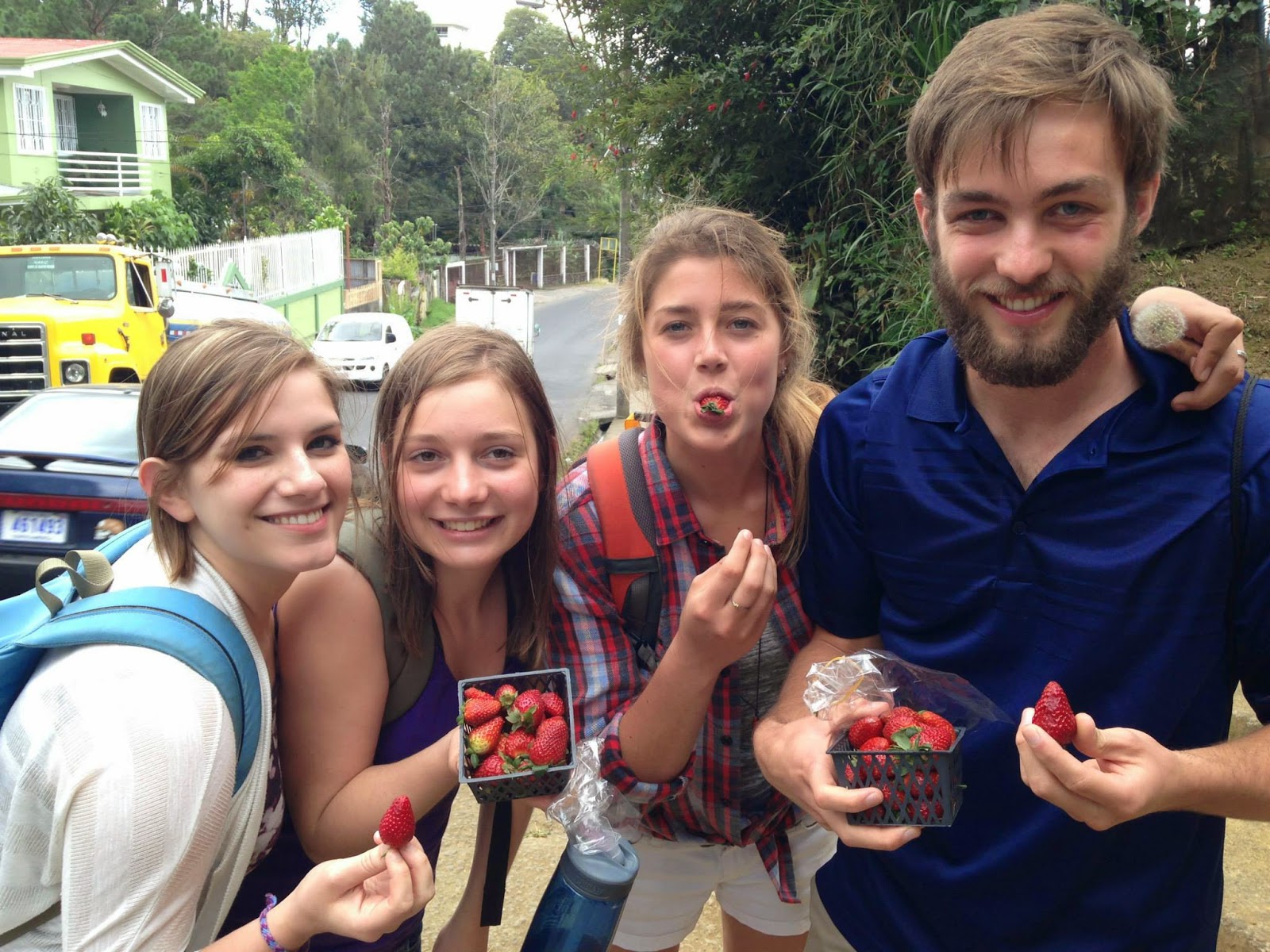

I feel that so often when folks like me, young, adventure-seeking, poor students (or anyone for that matter) come to another country or culture it is the things that are different, the “beautiful”, the “gross”, the “exotic”, the “charming” that we notice first and that we bring back with us as stories and photos. The “different” stands out like white on black or a meatball in the fruit-punch (I’ve personally never seen this and hope not too but it suffices for effect). I could go on and on about all the “strangeness” around me every day, not only in the food, sights, smells, and sounds but even in the behavior and attitudes of people themselves. Now I realize I might be leading you to believe that I think these things are wrong, but to the contrary in fact I think they are a large part of what expands our worldviews and even the capacity to have compassion, resolve, and love especially for the “other”. When I am the “other” in the “other’s” context it is the differences that challenge and break down my own preconceived assumptions and understandings of the world to build a more inclusive and holistic understanding. 
Now this is something I have been reflecting on lately and its fairly convoluted in my mind so I apologize if it spills through my fingertips that way too. From my first few days of orientation when absolutely everything felt different and was new and unfamiliar one quote from the director of my program still pierces my thoughts: “Be slow to judge for the strangers and the strange all around you are experiencing your strangeness.” How true that is, and how often it seems to me that the average North American abroad might never realize that it is THEM that is the strange and the different. With the advantage of having been given this insightful hint of advice I have been keenly aware to be aware, though I don’t always make it past the first “aware”, of my own outlandishness in this place. Now I won’t bore you now with all my displaced peculiarities, for you know many of them well within yourself as everyday habits and reactions, but let it be enough to know that they are very real and present everyday even though I might not always perceive it.
Up to this point I realize the title may seem fairly misleading. But it was necessary to talk about the importance of the differences before realizing the contradiction of the title. I have been here in Costa Rica now for almost four weeks and have barely scratched the surface but it has been enough to scratch away some of the veneer that shimmers as a blinding wall of otherness. And underneath all is not different. There are the little things that are the same like breakfast, lunch, and dinner and a universal enjoyment of the three. Or a morning shower, a bakery to treat oneself to doughy goodness, and jaywalking. But when I talk about similarities it’s not the little things I am thinking of, though those have come to be very important for a sense of groundedness. It’s the bigger, often less tangible, but more real similarities I am thinking of.

But allow me a little more background so you understand in part why I have been thinking of such things. The LASP program is about opening students eyes to the realities of Latin America; the problems, the successes, the language, the people, the history, and the relationship with North America among other things. And much of the classes in these subjects have brought on the realization of the terrible things we humans in general (and North America to Latin America specifically) are capable of doing to each other militarily, economically, and socially in the name of democracy, economics, growth, and safety. “Socialism” is not an excuse for Augusto Pinochet, or drugs, “the public enemy number one”, are not an excuse for torture, indiscriminate killing, and war in Colombia, and “neo-liberalism” is not an excuse for the Canadian company Infinito Gold to sue Costa Rica for a billion dollars when its people have chosen carbon-neutrality over foreign investment. And it is not an excuse to do all these things because others are so “different” or “alien” that the civitas, subconsciously or not, assent to it.
Maybe all too often we live and travel and experience with a kind of cultural myopia that only lets us see the little things at are feet that are the same while everything in front of us seems different and unknown. And maybe all too often we think in a way that identifies the similarities in the different rather than the differences in the similar. The first view allows us to visit, enjoy something exotic from our tiny viewpoint, and leave before it inconveniences us keeping the term “responsibility” nicely wrapped up for our little world at home. The second view calls us to realize a global responsibility with all humanity and to realize joy not suspicion at differences. But maybe you already knew that. Its in the Book. And its this second meaning of similarity I mean. Under the veneer are people who also know what it is to laugh with their friends not because something is funny but because they are experiencing the joy of fellowshipping together. Under the veneer are people who also see the sun and the stars and sometimes get the shivers for pausing to think about how tiny they really are. Under the veneer are people who have the same desire to be loved and to love and to live in relationships with others. And under the veneer of all those differences are people who are people too.
It’s our differences that should give us the compassion and wonder we need to work toward a better, inclusive global community but so often it’s the differences that lead to hate, to prejudice, to injustice, to poverty, to violence, to war. But then maybe it’s not the differences we need but the similarities. So together can we humble ourselves and finally pick up those glasses we’ve been given from Him and see that maybe it’s really our little things that are different and the big things that are the same.
Matthew 22:37-39
Jesus replied: “‘Love the Lord your God with all your heart and with all your soul and with all your mind.’This is the first and greatest commandment. And the second is like it: ‘Love your neighbor as yourself.”

Monday, February 2, 2015

Mission Statement Monday: Looking back...


Our first Mission Statement alumni post comes from Tim Honchel, who was a LASP student in Fall 2009. Follow Tim as he reflects on the semester abroad experience that introduced him to author (LASP friend & speaker) Elmer Hernán Rodríguez Campos and helped him find the path he is on today. You can read more about Tim's translation work here.
  After a transforming short-term mission trip to Honduras when I was 16, I knew that I wanted to do something different with my life and help change the world for the better. For a long time, I thought that meant becoming a missionary in Latin America, which prompted me to study abroad through the Best Semester Latin American Studies Program in the fall of 2009. My three months with LASP confirmed my convictions to do something out of the ordinary and gave me the tools, insights, and confidence I needed to get started. The experience also shaped those convictions in a way I would have never anticipated.

Experiential Learning
I came to LASP with a set of conscious and unconscious expectations, only to find that each day was an adventure and that I never knew what to expect. I had wanted to learn more about Latin American culture and life. Now I was immersed almost full-time with a Latin American family, observing and experiencing the ins and outs of everyday life. I had wanted to improve my Spanish so I could communicate better. Now I was finding that language was more than a collection of words and was allowing me to connect with people that I could barely relate to before. I had wanted to learn about Latin America in the present day, but I was also learning about the historical forces that have shaped and continue to shape the region. I had wanted to learn about poverty and how to help people escape it. Now I was meeting and hearing the stories of people who had been poor their entire lives. I was also meeting people who had very few material possessions but lived such rich fulfilling lives that they were redefining my perspective of poverty altogether. In summary, I discovered that my education included, but could go beyond the information contained in textbooks.

Seek First the Kingdom – Be Open to Critical Thinking
The lectures, experiences, and relationships from that semester in Costa Rica challenged me to question things I had uncritically taken for granted, to explore possibilities that I had never considered, and kindled a desire to understand other people and the world we live in. I was drawn back to Jesus’ teachings about the Kingdom of God and reminded that the world (even much of the Christian world surprisingly, including myself!) did not operate by or think highly of the principles he described and modeled.* I realized that I still wanted to change the world for the better, but the best way to start doing that might be to first make some changes in myself.
Find out more here.

Learning Never Ends – Global Awareness
I returned home committed to learn more about the Kingdom of God and the things that might be preventing us from living it out. I wanted to take at least a year to intentionally explore this ideal, this way of life. So after graduating college, I traveled through Central America and was welcomed with generous hospitality in every town I visited. I also saw how the products we enjoy are often made possible by importing natural resources and cheap labor from countries that have been allowed no other choices. I then moved back to the US, to a predominantly African-American urban neighborhood, where I became aware of my own unconscious racial barriers and fears, the numerous challenges facing American minorities, and was able to develop genuine relationships with people whose backgrounds were often very different than my own. Next, I went to work in a US oilfield and came to understand the effects, implications, and dependence of our economy and way of life on the world’s ecosystems that we are a part of and that sustain our basic needs; and the tendency to use economic policies and war for control of foreign resources. I interned at organic farms and enjoyed learning how to live more simply and work with others to more directly meet our basic needs. Finally, I helped translate and publish the powerful story of Elmer Hernán Rodríguez Campos, one of the friends I made during my time at LASP.

Where I am Now
I’m still on this journey and it’s one that has rarely been easy and will likely take my entire life (or longer). Learning how to sail in seemingly uncharted waters, living in a US culture when I have fairly different values requires a lot of my energy. There is plenty of stumbling and uncertainty, which as I learned from my experiences at LASP, can be an opportunity to grow even more. Instead of material wealth and convenience, I’ve found my wealth in deeper relationships, better health, personal freedom, and the knowledge that I’m learning how to live in a way that can hopefully make the world a better place. I’m doing something different with my life after all, and I’m now able to use my life experiences, planning skills, and business education to offer practical help to other groups and individuals that want to do something different and are trying to figure out how. This service is one way I try to give back and also how I earn a humble living. I love being self-employed.

Appreciation
My friends and fellow students, even though they came and left with various interests and goals, all benefited and grew from their time at LASP. I’m personally grateful to LASP for inspiring me to look deeper, ask questions, think critically, step out of my comfort zone, and work towards making my goals a reality. Three months of transformative learning has gone on to impact my entire life.

*Perhaps we do this because following Jesus’s teachings would require us to acknowledge the source of most problems and renounce that which we love most: ourselves. It is easier to reinterpret these teachings or place the focus on less demanding passages that require small sacrifices, postpone life’s meaning until after death, and put the blame on others. It takes courage, trust, and humility to admit that we are hurting others to benefit ourselves and then learn to change our ways.